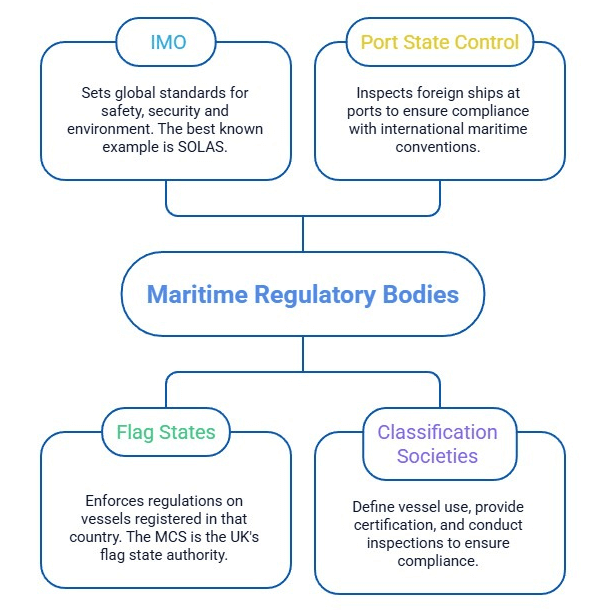
A (very) quick guide to regulatory bodies in the marine industry
How the IMO (International Maritime Organisation), flag states, and classification societies work
In the marine industry, the IMO (International Maritime Organisation), PSC (Port State Control), flag states, and classification societies are all fundamental regulatory and oversight bodies that uphold maritime safety, compliance, and environmental standards globally.
Here’s a quick guide to how they work.
The International Maritime Organisation
The IMO is an international regulatory body that sets global standards through conventions that govern maritime safety, security, and environmental protection. Perhaps the best known convention is SOLAS (the International Convention for the Safety of Life at Sea), which comprehensively covers aspects of marine safety, including fire protection, life-saving appliances, and navigation.
These global standards are enforced by national authorities (flag states) who may add country-specific requirements. As the regulations are routinely updated to reflect new safety research, technological advancements, and lessons learned from past incidents, staying current with these changes is essential to maintain compliance.
Flag States
A ship’s flag state is the country it’s registered under, and it is responsible for ensuring that its registered vessels comply with international laws, including inspection routines. Vessel owners need to register their vessels under the flag of the country where they are based.
What is an example of a flag state authority?
The Maritime and Coastguard Agency (MCA) is a flag state authority, representing the UK’s government in enforcing maritime regulations. It ensures that vessels under the UK flag comply with both national and international standards for safety, pollution prevention, and security.
Classification Societies
Examples of classification societies include Lloyd’s Register, DNV, and Bureau Veritas. They serve several critical functions:
Defining vessel use and compliance standards: Each vessel class specifies the intended use and operational parameters of the ship, such as cargo type or passenger capacity, which impacts the required certifications and inspections.
Certification requirements: Classification societies provide technical standards and issue certificates that confirm a vessel meets safety, structural, and environmental regulations. Certification ensures that vessels comply with international and national laws, allowing them to operate legally in specific waters and ports.
Inspection and survey regimes: To maintain class status, vessels undergo regular inspections and surveys covering structural integrity, safety equipment, and onboard systems. The classification societies conduct these surveys to verify continued compliance with their technical standards.
What is the difference between flag states and classification societies?
They have distinct but complementary roles:
The flag state enforces regulations and compliance on vessels registered under its flag (county), covering areas like safety, pollution prevention, and crew welfare. Flag states work alongside classification societies to verify compliance with international standards.
Classification societies create technical rules that govern the design, construction, and maintenance of ships to ensure structural and operational safety. They conduct inspections and certifications, which may also satisfy some of the flag state’s regulatory requirements.
Together, flag states and classification societies ensure vessels meet both regulatory and technical safety standards.
Port State Control (PSC)
Port State Control (PSC) inspects foreign vessels calling at a country’s ports to verify compliance with international maritime conventions, including IMO regulations like SOLAS, MARPOL, STCW, and the MLC. These inspections verify that the ship’s condition, equipment, and crew meet safety, security, and environmental standards.
PSC acts as a ‘second line of defence’ against substandard shipping when flag states or classification societies fail to enforce compliance.
Ships found with serious deficiencies may be detained until issues are rectified, ensuring maritime safety and environmental protection. This underscores why coordinated compliance across all three bodies is critical.
Bringing it all together: staying inspection-ready
If you’re responsible for safety kit, maintenance planning, or ship readiness ahead of inspections, understanding how these bodies interact is only half the job. The other half is making sure your firefighting systems, life-saving appliances, documentation, and onboard equipment are actually inspection-ready when it matters.
That’s where we come in: Star supports vessels with compliant supply, inspection, and servicing packages that help avoid delays, detentions, and last-minute scrambles. If you’d like a practical conversation about inspection readiness or streamlining your service agreements, just get in touch.